
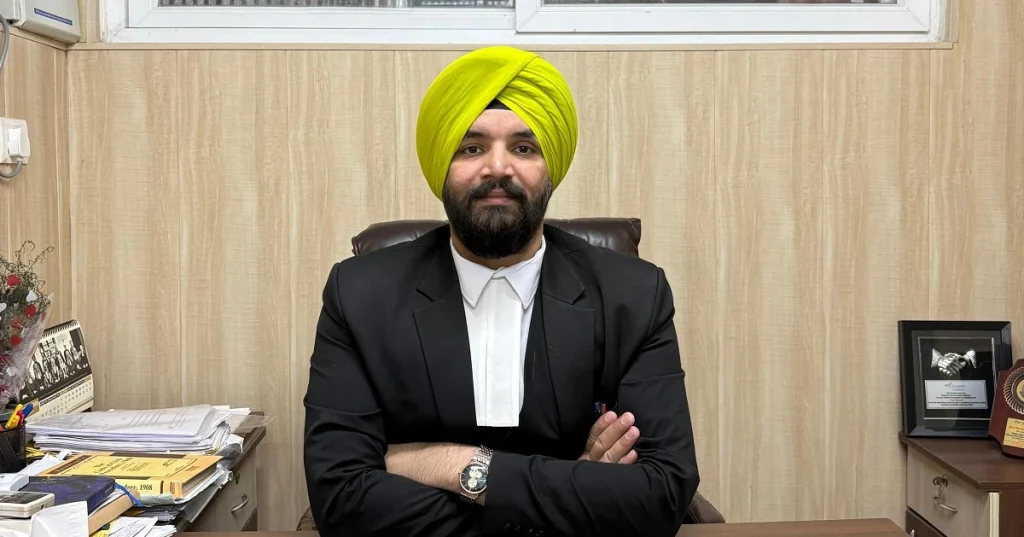

Grounded in a long standing legal legacy, this conversation explores the journey of Manik Ahluwalia, Founder of Manik Ahluwalia Law Offices, tracing his evolution from early mentorships and formative courtroom experiences to establishing an independent practice built on resilience, credibility, and disciplined growth. The interview offers insights into his work across litigation, arbitration, labour and employment law, and public law, while reflecting on the values and strategies that shape a sustainable and principled legal practice.
This interview has been published by Anshi Mudgal and The SuperLawyer Team
Being in the legal industry for over a decade now, what was your motivation to choose this field as a career?
I come from a family of lawyers. We have been in this profession for almost 90 years now. My grandfather Sardar Kuldeep Singh started his practice in Lahore and from there moved to India post-partition. My father, my uncles and my cousins all followed in his footsteps and joined the profession. So one would assume that law would be the natural choice of career for me. However, that was not the case.

I was a science student and an engineering aspirant. So JEE and AIEEE was what I was focussing on during my 11th and 12th. My father however was always inclined that I at least sit for a law entrance exam. So I sat for IP entrance and the legal genes took over from there. I got a rank much better than I did in many of my engineering exams. So one thing led to another and here I am. Once I entered law school, there was a dimensional shift in my thought process. The impact the field had on society in general, in our day to day functioning and how we perceive the society impacted me. While it will be really cliched to say that I found my calling but that’s actually what happened.
So I always say that I am a law student by accident but an advocate by choice.
During your initial years, while working with various lawyers and law firms, what experiences and mentorship helped you in laying the foundation of your practice?
I have always maintained that my first mentor has and always will be my father Sardar VPS Ahluwalia. Personal life aside, even from my law entrance exams till date, he is my go to person, confidante and mentor. Whenever I am stuck with any legal issue or an approach towards a legal issue, I used his vast experience of almost three decades. Of course other than him, I have my rest of the family in the profession whom I connect with when required.
Outside my family, the one person who really played a very important role in mentoring me was my first boss Mr. T.K. Ganju Senior Advocate. I joined his office in 2014 immediately after my graduation and had the good fortune of assisting him on a lot of original side and arbitration matters. In addition to assisting him, he used to promote and encourage us a lot to take up assignments independently. Whenever we had any doubt or trouble in navigating any issue, he used to always be very welcoming and always available to help us solve them.
The best thing about his approach towards his juniors was “You take the brief and work on it as the lead advocate, if anything goes wrong, I will handle it”. That one line gave us the confidence to take on matters and draft and argue with full confidence.
I am happy to say that I have been able to take forward this approach now when my juniors approach me and hopefully I am able to instill that confidence in them.
After working in the legal industry for over a decade, what was the turning point in your career that made you establish your independent practice?
As I said, I come from a family of practitioners so this was a natural progression. I had been working for more than 8 years and in 2023 I finally decided to take that plunge.
During my stint at P&A briefing the biggest names in the industry was a norm. While I really enjoyed that part of the job, I really yearned for the urge to appear in person and argue the matters on my own. So while there is no turning point as such that I can point out, all I can say is that it happened just as a way of natural progression.
You have more than a decade of experience in litigation and arbitration and are empanelled with several government bodies. How did this journey unfold, and what has been your motivation and commitment into reaching this stage?
Transitioning to independent practice was relatively easy; establishing an independent practice was not. Coming from a family of lawyers, there is often an assumption, both internal and external, that one would have a ready-made practice or at least a significant head start. I, too, carried that hope initially. The reality, however, was very different.
The first five to six months were particularly challenging. While I always had the option to join my father’s practice, there was little to no work of my own. My father constantly supported and told me that it was only a matter of time before work would start to flow in. Those months however, taught me discipline and resilience. I had to unlearn and relearn everything from scratch. Things like business development, reconnecting with old clients, setting up meetings, pitching for work, and most importantly, putting myself out there without hesitation became the new normal. I was very clear and transparent with people: I have set up my chamber, you know my work, and I am ready to take on matters.
The turning point came in September 2023, when I was empanelled with the Municipal Corporation of Delhi for labour and employment disputes. That panel changed the trajectory of my practice. Matters were being marked to me on a daily basis, and I was appearing before multiple labour courts every single day. The volume, responsibility, and pace of work gave me tremendous confidence and a sense of purpose. It reaffirmed why I had chosen this path in the first place.
Labour and employment law, interestingly, emerged as an unexpected but significant strength. While my inclination had always been towards commercial disputes and arbitration, the MCD panel allowed me to build credibility in labour and employment matters. That experience helped me advise and represent private clients on labour disputes and compliances. I realised early on that as long as businesses exist and people are employed, labour and employment issues will always remain relevant.
At the same time, I continued to consciously build my commercial and arbitration practice. Pitching to clients, taking up complex commercial disputes, writ matters, and advisory work became a usual routine and gradually, the practice became more balanced and diversified.
I also made it a point to apply for every government and PSU panel that I was eligible for. I was often told that without influence or a “jack,” getting empanelled is nearly impossible. I chose not to believe that. My approach was simple: I should apply, perform, and persevere. The worst outcome could only be a rejection, but there was always a chance of being selected on merit.
Over time, that perseverance paid off. I was fortunate to be empanelled with multiple government bodies and PSUs purely on merit. Each panel became a stepping stone bringing not just work, but credibility, exposure, and more opportunities.
Today, nearly three years into independent practice, I am empanelled with close to seventeen government and PSU bodies. The work that comes my way is diverse, demanding, and intellectually stimulating. More than anything, the journey has reinforced my belief that consistency, integrity, and perseverance are far more sustainable than shortcuts. That belief continues to be my motivation and commitment as I move forward.
How did you deal with the challenges that came with handling an independent practice?
I wish I had a more creative answer to this, but in my experience, the response is as simple and as clichéd as it gets: hard work and perseverance. This profession gives you the highest of highs and the lowest of lows, sometimes in quick succession. The real challenge is not merely maintaining composure in court, but finding something that keeps you going through the quieter and more uncertain phases.
Independent practice tests your patience, grit, and resilience. There are moments when it can be emotionally and professionally demanding, even lonely. While people often speak about the freedom of being your own boss, they forget the other side of it i.e. you are also your own employee. There is no one else to fall back on, no safety net, and every decision ultimately rests with you.
Another challenge is leadership. As an independent practitioner, you work with juniors, but there is always a professional distance to be maintained. Not everything can be shared, and that can sometimes make the journey feel isolating. In many ways, this profession functions like an ECG—sharp highs, sudden lows, and constant movement. The only way forward is to keep working, keep persevering, and allow the profession to eventually give back.
On a lighter note, setting up my own chamber also taught me how much we take for granted at home and in a secured job environment. I still remember that making a simple cup of tea in my new office took me three days because I hadn’t accounted for basics like gas, utensils, or even a strainer. That small incident perfectly captured what independent practice is like: from managing court work and clients to handling billing, administration, and business development; everything becomes your responsibility.
Today, while I recognise that there is still a long way to go, I can say with confidence that this profession is deeply rewarding. It demands a lot, but if you are willing to put in the work and stay the course, it gives back in ways very few professions do.
What has been one of the most challenging cases you’ve ever handled and how did it shape or shift your perspective on approaching future matters?
It was not one single case, but a combination of a few matters that fundamentally shaped how I approach litigation and advisory work today.
The first was early in my career while working with Mr. Ganju, where a trial court had held that mortgage by deposit of title deeds was not applicable to Delhi. On detailed research, we were able to trace a specific notification extending the provision to Delhi, and the finding was challenged in appeal. During the hearing before the High Court, I was unexpectedly asked to assist the Court on the issue. Now this is where the great of my father and Mr. Ganju came to my rescue that always read your brief. Even if you don’t have to argue, you should always prepare your file. Now as I had read the brief cover to cover, I was able to take the Court through the notification and the error in the trial court’s reasoning. That experience reinforced a principle I still follow i.e. never walk into court unprepared, irrespective of whether you are slated to argue or not. Courts acknowledge preparation, and opportunity often comes when you least expect it.
The second formative experience was during the early years of my second job and the Insolvency and Bankruptcy Code, when we were handling post-resolution litigation after a major corporate acquisition. At that stage, the law was still unsettled, and tax authorities across the country were initiating recovery proceedings despite an approved resolution plan. We were litigating before multiple High Courts simultaneously. That phase taught me the importance of restraint. When the law is evolving, every argument and every observation can have a cascading effect. We had to tread very carefully as any slight adverse order/observation could put to question the integrity of the approved Resolution Plan. I realised that effective advocacy is not always about pushing every available point, but about knowing how much to say, when to say it, and before whom.
The third matter involved challenging the continuation of arbitral proceedings after approval of a resolution plan, at a time when the statutory framework offered no clear appellate remedy. Taking the route of invoking writ jurisdiction against arbitral orders was a calculated risk, given the courts’ self-restraint in arbitration matters. However, the legal foundation was strong, and the Court granted interim protection. That decision later served as a basis for relief in multiple similar proceedings. This matter taught me that measured risk-taking is sometimes essential, particularly when procedural law does not provide an effective remedy.
Collectively, these matters reshaped my approach to practice. They taught me that good lawyering lies in preparation, strategic restraint, and the ability to take informed risks. Those lessons continue to guide how I assess and approach matters today.
Looking forward, what vision do you have for your practice and how do you stay updated on the latest legal trends?
Looking ahead, my vision is to build a practice that is known for depth, reliability, and clarity of advice rather than sheer volume of work. I am keen on strengthening my core areas viz. commercial disputes, arbitration, labour and employment, and public law while ensuring that the practice remains structured and process-driven. As the practice grows, my focus is also on building a strong second line, mentoring younger lawyers, and creating a team that values preparation, ethics, and accountability.
I am equally conscious that the nature of disputes is evolving. Courts, tribunals, and clients today expect lawyers to be commercially aware, procedurally sharp, and solution-oriented. My objective is therefore not just to litigate disputes, but to help clients navigate risk, compliance, and strategy in a way that avoids unnecessary litigation where possible.
As far as staying updated is concerned, I believe continuous learning is non-negotiable in this profession. I regularly track judicial developments across High Courts and the Supreme Court, especially in arbitration, insolvency, and service jurisprudence. I make it a point to read judgments in full rather than relying only on summaries, because context often matters as much as the ratio. I have always been a very avid reader so that habit comes really handy in this profession. Interacting with peers, appearing before different forums, participating in professional discussions, and engaging with academic and institutional platforms also play a key role in keeping me current.
Ultimately, the vision is simple: to build a practice that evolves with the law, earns the trust of clients and courts alike, and remains intellectually honest and professionally sustainable.
What advice would you offer to the students who wish to establish a sound understanding of Arbitration matters?
My advice to students who want to build a sound understanding of arbitration is fairly straightforward—read extensively and stay curious. Arbitration is one of the fastest-evolving areas of law. With cross-border transactions, technology-driven disputes, fintech, and digital assets becoming commonplace, the landscape of arbitration is changing almost every day. To stay relevant, you must constantly know where the law stands today and where it is likely to move tomorrow.
What makes arbitration particularly interesting is its flexibility, party autonomy, commercial pragmatism, and procedural innovation. With technology enabling virtual hearings and cross-jurisdictional participation, borders today are often reduced to lines on a map. An arbitrator, parties, and witnesses can all be in different jurisdictions and still conduct effective proceedings. This is only going to increase.
I would also urge students not to approach arbitration in a conventional or rigid manner. Think one step ahead about how disputes will arise in the future and how they will be resolved. In my view, arbitration is gradually moving from being merely an alternative dispute resolution mechanism to becoming a mainstream mode of dispute resolution, and it is here to stay.
Finally, engage with practitioners, ask questions, and seek guidance. The arbitration community is far more open and collaborative than it is often perceived to be. If you read consistently, stay updated, and remain forward-looking, especially in emerging areas like technology and fintech disputes, you will find arbitration to be a deeply rewarding field to build your practice in.
Get in touch with Manik Ahluwalia –



This online course from UNICCM School delivers essential learning concepts clearly, and it maintains consistency so children stay on track. The advantages include a user-friendly format and reliable resources, and the benefits promote steady academic growth. The Steps to a child’s brighter future start with simple online lessons, develop through structured activities, and continue with UNICCM School’s guidance.
Strong language foundations are developed through Class 9 CBSE English , where grammar, literature, and writing skills are taught in a structured way. Clear explanations improve comprehension and expression. UNICCM School offers a curriculum-aligned course for steady academic progress.
Learning about nature and society becomes easier with structured Class 2 CBSE EVS content. Simple topics encourage curiosity and awareness. UNICCM School provides a dedicated course for consistent academic development.
Easy access to study materials starts with cbse class 4 maths book pdf , covering numbers, shapes, and basic problem-solving. Clear content helps build strong basics. UNICCM School offers a CBSE-aligned course for steady learning.