
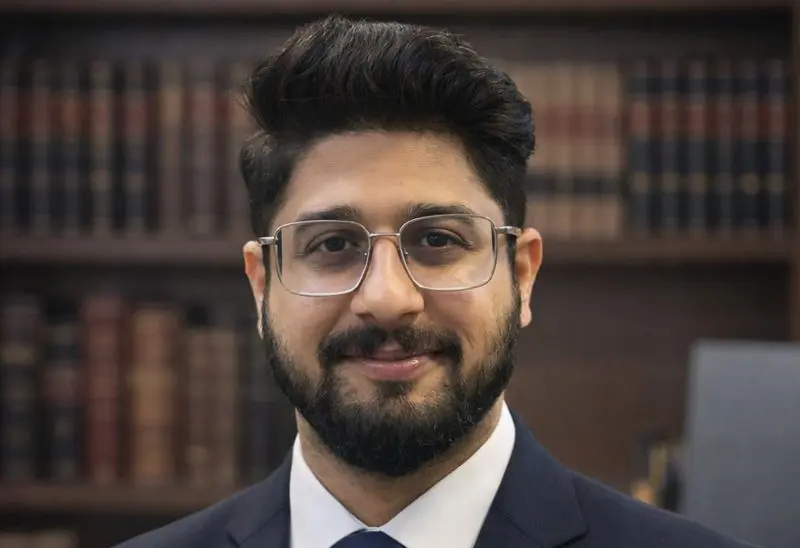

Gitesh Chopra, Senior Associate at Kochhar and Co., is a litigation lawyer whose practice spans civil and commercial disputes. In this conversation, he reflects on how the courtroom shaped his understanding of the law as a process rather than a fixed formula. Tracing his journey from the early, humbling days of advocacy to the structured demands of law firm practice, he talks about learning to balance legal reasoning with client realities. The interview offers insight into the making of a commercial lawyer focused on strategy, precision drafting, and meaningful impact.
This interview has been published by Anshi Mudgal and The SuperLawyer Team
What first pulled you toward litigation, and how did your earliest days in court reshape your understanding of law?
Honestly, it was the fact that the law isn’t black and white. There’s no fixed formula, just a lot of grey, and that’s where a lawyer can really make a difference. I had seen it time and again how a single PIL could bring an issue to court, or how one order or judgment could actually change things on the ground. Being at the frontline of that process, where your arguments can translate into real impact, is what drew me to litigation.
The early days were pretty humbling. The court teaches you very quickly that law on paper and law in practice are two very different things. You could have a great case and still lose the room if you weren’t clear or prepared. I learnt early on that confidence in court isn’t something you carry in with you rather, it’s something you earn, day after day.

Moving from litigation into law firm practice, what major differences did you observe, and how did your practice evolve as a result?
The biggest shock was realising that clients don’t care how elegant your argument is, instead, they care about outcomes and timelines. In chambers, success is arguing well. In a firm, success is solving the client’s problem without creating new ones. That forced me to mature fast and think practically and sometimes even telling clients things they didn’t want to hear in a way you don’t lose them – something you learn in a law firm.
In the early years of your career, what was the toughest challenge that truly enhanced your understanding?
The toughest challenge was feeling underprepared but still being expected to deliver. There were moments when I was handling serious matters and thinking “I hope I don’t mess this up”. That pressure taught me discipline. I stopped cutting corners, started over-preparing, and learned that fear, if handled right, makes you alert and sharper.
Was there a defining turning point that fundamentally changed the direction of your career?
Yes, when the safety net disappeared. The moment I started to cater to the clients directly and independently, basically when I became the person clients called directly and teams depended on, everything changed. You can’t hide behind seniors then. That responsibility forced me to own my decisions, my mistakes, and my learning curve. It was uncomfortable, but necessary.
Among the complex disputes you have handled, was there a case that was particularly interesting to you?
Personally, I like matters where I can sit with the file and really deep dive, understand the facts, the nuances, and what’s actually going on beneath the surface. But more than that, I’ve always been drawn to work where what I do matters beyond just the case, either to the larger public or to someone who genuinely feels helpless. That drives me.
I still remember taking up a pro bono matter for a senior citizen who was being harassed by her own sons over property. It didn’t feel like a choice, it felt like something I had to do.
On the other hand, I got the opportunity to work on the Aircel insolvency, representing the Department of Telecommunications as an operational creditor. It was my first insolvency matter, and given the scale of the case, it was a steep learning curve. One of the key issues was assisting courts in grappling with whether a telecom licence and the “right to use” spectrum, held by Aircel but owned by the public through the Government, could continue through insolvency proceedings. Working on questions of law that had the potential to affect how spectrum assets are treated in insolvency and, by extension, influence how telecom companies are resolved, was a genuinely fulfilling experience.
Both the pro bono matter and the Aircel case reinforced the same thing for me: the work matters, whether it affects one individual or an entire sector.
As you stepped into leadership and began managing teams and client expectations, what internal shifts did that responsibility demand?
I had to unlearn the habit of doing everything myself. Early on, I equated control with competence. Leadership taught me that control limits growth, both the team’s and yours. I had to become calmer, more patient, and more trusting, especially when things didn’t go perfectly.
How do you stay current with evolving legal trends, and what advice would you offer young law students navigating the profession today?
I pay attention to how judges think, not just what they write. Orders, courtroom behaviour, and patterns matter more than theory. To students, I would say “don’t chase glamour early. Learn how to draft properly (especially in the age of AI), learn procedure, and learn how to stand your ground politely. With the increasing use of AI, the discipline of drafting becomes even more important. At an early stage, drafting trains you to recognise your own errors, refine your reasoning, and develop precision in expression. Underpinning this is a principle I have learned through experience: think complex, but write simple. That habit of clarity and self-correction, over time, directly feeds into sound judgment and more effective legal strategy. Everything else follows in due course.
How do you cope with the demands and pressures of the legal profession, and what future are you consciously building for your practice?
Earlier, I used to think exhaustion was a badge of honour. With experience, I have realised it’s actually a liability. That being said, let no fool you otherwise, this profession does demand hard work, and there’s no escaping that. It may sound contradictory, but it is not; sustained effort matters far more than constant burnout. I cope by being disciplined about preparation and time management, because uncertainty creates more stress than workload. Staying calm in court and with clients by focusing on what is within my control, is another important perspective. The best way to understand this balance is to be at the Bar and experience it firsthand. This approach is what has worked for me so far.
I am still in the process of shaping my practice, but my direction is becoming clearer. I am deliberately leaning into commercial matters, especially arbitration and insolvency. Constitutional work continues to interest me, but my focus going forward is to grow into a reliable commercial disputes lawyer who can think strategically and draft with precision.
Get in touch with Gitesh Chopra –



Great to read the interview. Very realistic and practical replies by Adv. Gitesh. Great journey, great work. Kudos.