
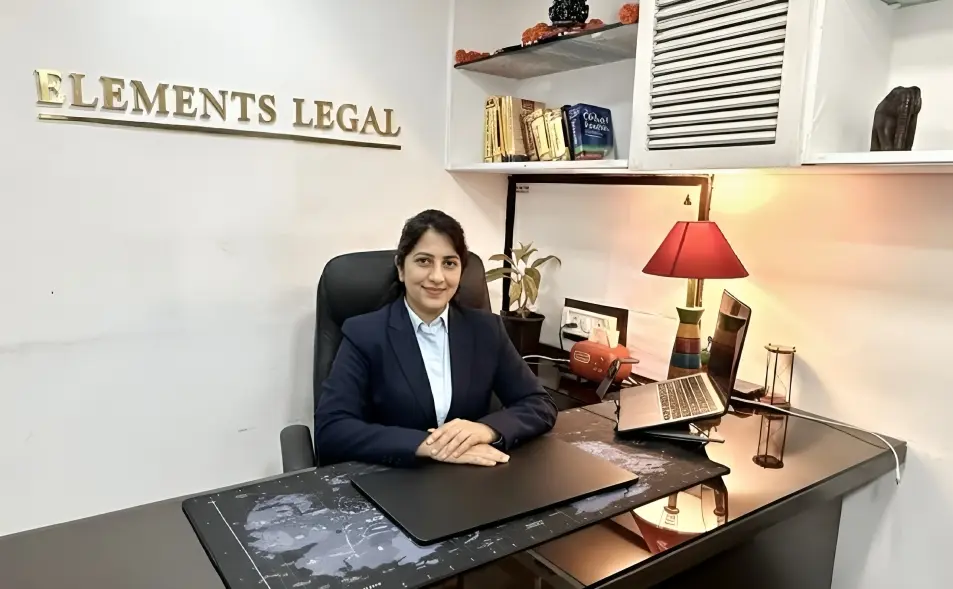

Tanya Chaudhry, Advocate on Record at the Supreme Court of India and Partner at Elements Legal, represents a new generation of litigators grounded in constitutional rigor and strategic clarity. From questioning the status quo as a child to arguing complex matters before the Supreme Court, her journey reflects unwavering discipline and conviction. A first-generation lawyer, she built her career through rigorous research, merit, and courtroom precision, while bridging constitutional advocacy with the evolving landscape of digital intellectual property law.
This interview has been published by Anshi Mudgal and The SuperLawyer Team
Looking back at your early years in law school, what first inspired you to pursue law as a career?
My journey into law was driven by a childhood instinct to question the status quo, a natural inclination for inquiry that I eventually recognized as a calling for advocacy. As a first-generation law student, I didn’t have a family legacy to follow, so my inspiration came from the realization that law is the ultimate tool for structural change. I was drawn to the challenge of mastering a craft where the reading and learning never stops and every case presents a new syllabus to conquer. This internal drive was later galvanized during my internship with the Late Mr. P.P. Rao, Sr. Adv., who showed me that a lawyer doesn’t just study the Constitution, they “breathe life” into it. That transition from a curious student to a dedicated advocate confirmed that I hadn’t just chosen a career; I had found my professional identity.
During the initial phase of your practice, what were the moments that tested your resolve and strengthened your decision to remain in the profession?
The initial years of any lawyer are a gruelling test of hard work and persistence, especially a first-generation lawyer. I vividly remember the nights spent feeling the weight of exhaustion and the imposter syndrome that often haunts those without a legal lineage. My resolve was tested during my formative years at Parekh & Co., where I transitioned from theory to the high-stakes reality of the Supreme Court and International Commercial Arbitrations. The moment that solidified my place in this profession was the profound satisfaction of discovering that one specific case law or a nuanced legal point after hours of digging through the archives and research. Seeing that research accepted by the Partners and subsequently hearing it being cited by legal legends in the Supreme Court was an incomparable high. It transformed the struggle into a sense of purpose and taught me that in this arena, your merit and your labour are your only currency, and that realization strengthened my decision to stay and excel.

Having worked with some of the most respected names in the industry, how did those experiences shape your ethics, discipline, and approach to the courtroom?
My approach to the courtroom was shaped by a front-row seat to how legal history is written, having assisted legal luminaries such as Late Mr. Fali Nariman, Sr. Adv., Mr. Harish Salve, Sr. Adv. and Mr. Mukul Rohatgi, Sr. Adv. These experiences instilled in me a deep respect for the “structural integrity” of an argument. My courtroom ethics are rooted in the discipline I observed from these legends, where absolute preparation is the only way to honour the court’s time. Today, as an AoR, my approach is defined by combining the technical rigor of constitutional traditions with a modern delivery that ensures every argument of the case is robust enough to withstand the highest scrutiny. I learned that success isn’t about volume, but about the precision of the elements built for each case, a philosophy I now carry as a Partner at Elements Legal.
Was there a defining turning point that guided you toward the path you walk today?
A significant turning point occurred when I shifted from traditional disputes at Parekh & Co. to the contemporary challenges at Solaris Legal in 2023. This tenure allowed me to tackle the new frontier of IPR laws, realizing that the legal landscape was rapidly evolving. However, the ultimate realization of my identity came in 2025, when I achieved the milestone of becoming an AoR at the Supreme Court. This achievement allowed me to seamlessly bridge the gap between high-stakes Arbitrations and the technical rigor required of an AoR. Today, I view myself as the perfect combination of contemporary and traditional law for research and delivery.
Can you recall a particularly challenging case in your career, and how did you navigate its complexities?
One of the most complex challenges was representing a minority religious denomination before a 9-judge Constitutional Bench in the Sabarimala case. This required balancing centuries of tradition with modern constitutional morality through exhaustive historical and legal research. More recently, I navigated digital complexities in IPR for a Domain Name Registrar and its protections under the IT Act. My approach has always been consistent, a crisp, persuasive summary/synopsis is the most vital opportunity to secure the Court’s intervention.
Having handled numerous intellectual property litigations, what do you see as the most significant challenges entities face in the Indian legal landscape today?
The most significant challenge for modern entities is the rapid shift into the digital frontier, specifically the rise of AI-generated content and deepfake videos. These technologies create unprecedented hurdles for trademark, copyright, and personality rights. During my time at Solaris Legal, I saw how global brands and public figures must now defend their identity against digital infringement. For example, in the Anil Kapoor personality rights matter, the challenge was balancing protection with technology. Success today requires an advocate who is as steadfast as they are adaptive, ensuring that their protections stay ahead of the evolving digital-age disputes.
Becoming an Advocate on Record is a rare milestone, what responsibilities come with this recognition and how have they shaped your role before the Supreme Court?
Becoming an AoR was a defining moment that solidified my professional identity. This role carries the heavy responsibility of ensuring every dispute meets the highest technical standards of the Supreme Court. Being an AoR is not just a title; it is a position of immense responsibility that requires a specific technical rigor to bridge the gap between complex disputes and the Supreme Court’s high-pressure environment. It has transformed me into a practitioner who balances the needs of contemporary commercial law with the solemnity of constitutional advocacy, ensuring every argument has the structural integrity required for the highest court in the land.
During the most difficult phases of your professional journey, what belief kept you moving forward despite uncertainty?
As a first-generation practitioner, I frequently faced the uncertainty of carving my own path without a family legacy to lean on. The belief that law requires a constant evolution and the learning never stops was my primary anchor through every professional storm. I am also deeply supported by a circle of family and friends, including my husband, Bharath Gangadharan, who is also a practising advocate. While he navigates the complexities of Energy and Insolvency (IBC) laws, we share a mutual respect for the late-night research and grit required to stay ahead.
Looking ahead, what do you envision for yourself and your practice in the years to come?
Looking ahead, my vision is to grow Elements Legal into a firm where we “build the right elements” for every unique case. As an AoR, I intend to further integrate my experience in contemporary disputes that help shape the law and high-stake Arbitrations with the rigor of constitutional practice. Beyond commercial success, my practice will contribute to the evolving jurisprudence of digital rights and constitutional clarity. Having transitioned from the mentorship of legends to leading my own practice, I am focused on providing advocacy that is both modern and steadfast. I envision a practice that continues to write legal history, whether through complex commercial suits or pivotal Supreme Court interventions. My goal is to remain the perfect combination for clients navigating an ever-changing legal landscape. I thrive in environments where traditional and modern law collide.
Get in touch with Tanya Chaudhry –


You combine sharp legal insight with genuine empathy—an invaluable quality in a lawyer.Super impressed with dour dedication and work ethics👏
No comment provided.
Excellent. Thought provoking