
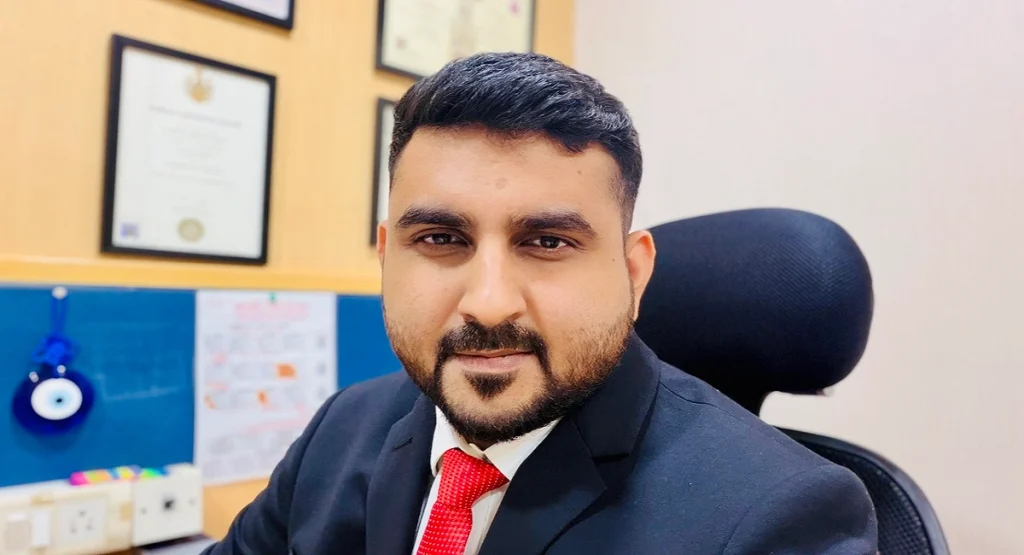

Tanay Mandot, Founder of Chambers of Tanay Mandot, practices in dispute resolution with a focus on international arbitration, commercial disputes, and litigation. He shares his journey into the legal profession, from discovering an early interest in advocacy and strategy to pursuing an LL.M. at Brunel University London. In this interview, he reflects on his early years in litigation, the experiences that shaped his interest in dispute resolution, and the transition into independent practice.
This interview has been published by Anshi Mudgal and The SuperLawyer Team
What were the instances in your early career that made you pursue law in the first place?
It wasn’t a single moment for me. It was more gradual. I’ve always been drawn to situations where there are competing sides to a story, and the outcome depends on how well you can present your case.

Early on, I realised that law sits at the intersection of logic, strategy, and real-world impact. It’s not just about knowing the law but how you use it. That ability to influence outcomes, sometimes quite significantly, is what pulled me in. Over time, what started as curiosity became a very deliberate choice.
How was your experience pursuing an LL.M. in International Commercial Law at Brunel University London, and what should aspiring law students keep in mind while applying?
My LL.M. at Brunel was a very defining phase. It gives you a completely different lens. You’re no longer looking at law only from an Indian perspective, but from a global, commercial standpoint.
What I appreciated most was the focus on thinking and analysing, not memorising. You’re expected to question, analyse, and form your own views. Also, being in a classroom with people from different jurisdictions changes how you understand even basic concepts.
For anyone considering an LL.M., I’d say don’t do it just because it sounds like the next step. Be clear about why you’re going. Whether it’s specialisation, exposure, or a career shift, your reason should guide your choice of university and course. And equally important, think about what you plan to do after you come back. The degree should fit into a larger plan.
In your early years of practice, which experiences played a pivotal role in shaping your interest in dispute resolution?
The early years were all about exposure. I had the opportunity to work on matters where things were constantly evolving no two days were the same. There used to be days where I have worked on 4 different areas of law and in different courts.
Courtrooms, in particular, had a big impact. Watching how judges respond, how arguments are built and dismantled, it teaches you things no textbook can. At the same time, arbitration introduced me to a more structured, documentation-heavy side of disputes.
Somewhere between the unpredictability of litigation and the precision of arbitration, I found what I wanted to do.
What was the defining turning point that led you to transition into independent practice?
There isn’t a perfect moment for that decision. It’s more about reaching a point where you feel ready to take ownership of your work, your clients, and your decisions.
For me, it came when I felt I had enough grounding to handle matters end-to-end. Independence is as much about responsibility as it is about freedom. It pushes you to think differently not just as a lawyer, but as someone building something of their own.
It’s a difficult shift, but an important one.
How did handling high-value arbitrations, particularly before the Singapore International Arbitration Centre, influence your strategic approach to complex disputes?
Working on matters before the Singapore International Arbitration Centre (SIAC) changes how you approach disputes. There’s a certain discipline to it, everything has to be precise.
You don’t have the luxury of being repetitive or vague. Your pleadings, your documents, your arguments, everything needs to be tightly structured. It forces you to think ahead, anticipate the other side, and build your case accordingly.
That experience really shaped how I look at complex matters now. I focus a lot more on preparation and clarity than I did earlier.
What have been the most significant challenges in balancing a practice spanning criminal litigation and commercial arbitration?
They’re very different worlds.
Criminal matters are often urgent and unpredictable; you’re dealing with immediate consequences, and decisions have to be taken quickly. Commercial arbitration, on the other hand, is more measured and documentation-driven.
The real challenge is switching between these two mindsets. One requires quick thinking under pressure, the other requires sustained focus and long-term strategy.
But in a way, working across both also sharpens your overall approach. You learn to be both responsive and strategic.
Is there a guiding principle or professional motto that has consistently shaped your approach to law?
If I had to put it simply – keep it clear.
There’s a tendency in our profession to overcomplicate things. But the more clearly you can present your case, the more effective you are. Whether it’s in court or in writing, clarity makes a difference.
Also, consistency matters. The way you approach your work, your clients, and even opposing counsel, it all builds your professional identity over time.
Could you share one of the most challenging matters you have handled and how you navigated its complexities?
One matter that stands out involved parallel proceedings across different forums, with both criminal and commercial elements involved.
The difficulty wasn’t just the law, it was managing how everything fit together. What you argue in one forum can have implications in another, so you have to be very careful about consistency while still maintaining a strategic edge.
The key was to break the problem down and deal with each issue in its own space, but always keep the larger picture in mind. It required a lot of coordination and forward planning.
Looking ahead, how do you envision the evolution of your practice, and what advice would you offer to young lawyers aspiring to build a similar career path?
Going forward, I see myself working more on complex, high-value disputes, especially those with cross-border elements. That’s where things are increasingly headed.
For young lawyers, I’d say focus on the basics. Drafting, procedure, and understanding how cases actually move, these things matter more than anything else.
Be patient with the process. The early years can feel slow, but that’s where you build your foundation. And try to put yourself in environments where you’re challenged. That’s where the real learning happens.
There are no shortcuts in this profession and there is no substitute for hard work. But if you stay consistent, things do come together over time.
Get in touch with Tanay Mandot –