
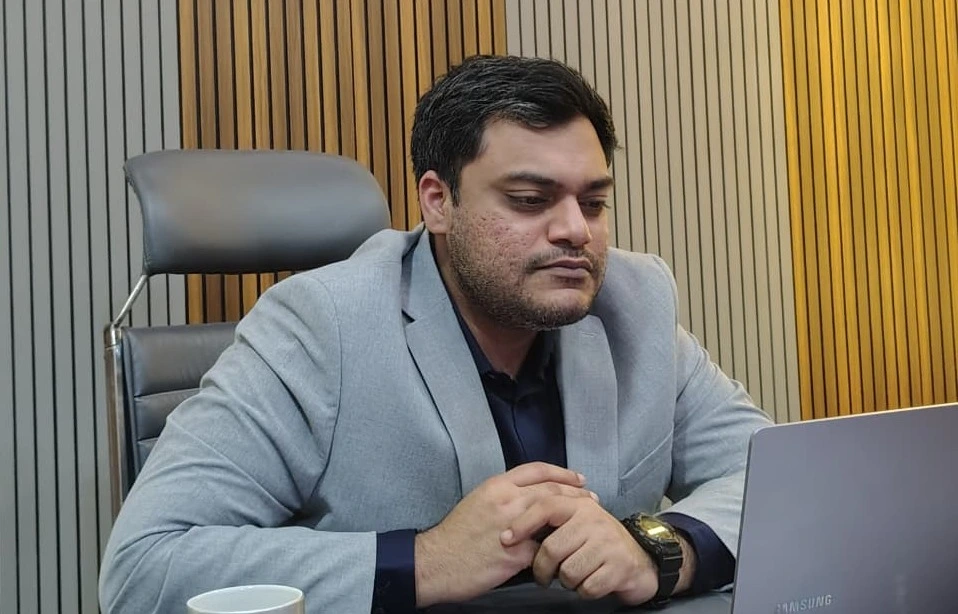

From humble beginnings to representing the Union of India before the Supreme Court and Delhi High Court, this in depth conversation traces the remarkable journey of Abhinav Mishra. As a first generation lawyer, he reflects on the inspiration that led him to law, the early struggles of litigation, building Chambers of Abhinav Mishra from the ground up, handling landmark commercial and government matters, and the values that continue to guide his practice. This interview offers rare insights into perseverance, integrity, government litigation, and the realities of building a sustainable legal career in India.
This interview has been published by Anshi Mudgal and The SuperLawyer Team
Being a first generation lawyer and coming from a very modest beginning, could you take us through your early journey and what initially inspired you to pursue a career in law? Additionally, what were the initial years in your practice like?
Sure, certainly, If I have to begin, I will simply start with the fact that my journey has been similar to that of any other first-generation lawyer in the profession. So if you ask me how things shaped up and how they started, this is how it all began.

It started with meeting a senior who had qualified the CLAT examination and was selected for WBNUJS, Kolkata. I met him through a family friend, and we were all having a nice gala time. He then told me that he was about to join WBNUJS in July. At that point in time, I did not know what WBNUJS was.
So I asked him what it was. He then told me that it is one of the premier law colleges, a National Law University, and that only a select few who qualify the CLAT examination get through. That was the defining moment which made me realize that I could even become a lawyer and that I also wished to become one.
I wanted to enter a National Law University and pursue my bachelor’s degree in law, and since then, this has been the driving force. When I entered law school, things were quite different. Although mooting and debating were given a lot of priority, there were not many enthusiasts who actively took up those activities.
From my batch onwards, things became more strategized and regularized. Students, batchmates, and seniors from two or three batches came together, and we started a student-run body for moot courts, debating competitions, clinical legal education, and other activities.
From there emerged the ideology of taking responsibility. Since we did not have mentors or faculty members to guide us on how to secure funds for events, invite guests, or ensure participation, everything came from personal experience and by observing colleges, institutions, and committees from different universities.
As we started doing these activities, and doing them on a larger scale, we gradually became mid-tier event organizers by the time we reached the fourth year of law school. Thereafter, we also began to understand that if we could do things for the college, why could we not do things for ourselves? What was the harm in beginning as a first-generation independent lawyer at a young age, rather than struggling for ten years as a junior or associate with a senior counsel and then deciding what to do next in the traditional manner?
Another thing I would like to say is that everything depends on having the willpower and zeal to achieve something. In my case, had I not had that zeal, I would not have been in front of you today. That has been the driving force because even today, after spending ten years in the profession, when you ask me what motivates me to work harder tomorrow, I would say that SuperLawyer has been kind enough to select me for this interview.
I would like to be part of such big organizations and their events in the near future as well. That has been the zeal. Eventually, it also came down to working for the government, since I belong to a civil servant family. Working for the government was always on the charts, and working with the government at such a senior level also makes us realize the kind of responsibility the profession expects us to shoulder.
When stakes of such large entities are involved and you are appointed to manage them, the pride comes from within as you strive to achieve something in the process. So this has been my journey, whether you call it initial or present. The zeal to join law school stemmed from a family friend who now happens to be a professional senior.
Sir, looking back, what would you describe as the turning point that transformed your journey? Was there any particular moment that you felt that this was transformational and set your path across?
Thank you for this question. I will begin by saying that every day transforms you in some manner. When you begin as a youngster in the profession, the transformation may come from being entrusted with a significant matter by your professional senior in the office, to work on and assist him.
Eventually, the turning point shifts to independently handling clients for your seniors. This then progresses to facing the courtroom as a counsel and making a full-fledged argument in a matter. For me as well, the journey has been exactly like this. I would not say that there has been one defining turning point in my professional career.
Yes, there are matters and there are facts of cases which, when you hear them, make you feel like working for the cause. In that sense, Anshi, I would say that we as lawyers encounter turning points every day or every week in our profession. To conclude on what I would look back upon, I would look back at the teachings I have received from my experiences in the profession. I would look back at the mentors who have blessed me through the process, who have placed their faith in me, who have marked matters to me, who have recommended my name for government appointments, who gave me my first matters, and who continued to entrust me with work.
This was because the results aligned with what they had expected. In that manner, Anshi, every day has been defining, and every day is a turning point in your career. Some make it through, and some break under it. The choice is entirely yours. When I had begun, there were days when we were not paid a single penny.
That is the reality of litigation life. Even in cities like New Delhi and Mumbai, though they may pay you the basics, you eventually realize that the amount runs out by the twentieth or twenty-first of the month. The last eight or nine days then become a period of survival crisis in the early years.
That, too, was a turning point in my profession.
You need to do something beyond what you are being paid, otherwise you will not be able to sustain yourself. Another defining moment came when a client approached me and handed me a very handsome cheque, and two weeks later, another client came to me with folded hands, saying that she would not be able to pay anything.
Fortunately for me, I represented both of them. The client who paid me lost the matter, while in the case of the client who could not pay, I secured a reportable judgment. That was the turning point which taught me that you do not restrict yourself in choosing matters. You take up everything that comes your way because you do not have generational legacy or generational experience backing you.
People are not waiting for you to graduate from law school so that they can mark matters to you. You need to procure them, secure them, ask for them, fight for them, take them, and eventually win them.
Today serving as a panel council for several PSUs and government bodies, how do you go about building such a strong, incredible practice from the ground up, the Chambers of Abhinav Mishra, how did you start and what were the experiences that you had building your practice?
Okay, so how did I start building my practice? With the assistance of a few colleagues in the profession who were genuinely not looking to make profits from me. That is how it starts, when you find people who share a common ideology, who are not there merely to do a job with you, who are not working with you as a matter of employment, but who stand with you as a team.
That is one thing which, I believe, builds everyone’s practice in this profession, and it happened with me as well. I am fortunate that in my initial years, and even now, I am blessed to have a team of colleagues whom I call family. There are days when we are good to each other, and there are days when we are rude to each other, because law is a profession that entails a great deal of strictness and discipline.
But eventually, when the sun sets and you are in the process of unwinding, it is this set of colleagues who will come and sit with you. That sense of belonging which I received from my initial team and my present-day team has built a major portion of my practice.
The next aspect, Anshi, that contributed to building my practice was a sense of fear and anxiety that comes with being a first-generation lawyer, the fear of losing a case and eventually losing a client. When you are under pressure to perform, you may not always want to perform, but your conscience intervenes at the right time and pushes you to deliver.
For me, this translated into applying to agencies, PSUs, and government bodies. I appeared for interviews and went through repeated rounds of shortlisting. It took time, but eventually my name appeared on the merit list. I then approached them and requested that they mark a case to me so they could assess my performance, and they did.
At that stage of my career, I was not very confident that I would be able to extract a strategy or build a case that would lead to a favourable order for the client. That sense of fear, however, pushed me to perform, and once that fear starts fading, your performance improves, and that performance eventually builds your practice.
The third factor was a very dedicated and supportive team of people in our law office, whom we refer to as our support staff. Whether it was following up on delayed professional fees or managing the everyday functioning of the office, their support has been invaluable. You know how a lawyer’s office works, and their contribution has been incredible.
And of course, the youngsters I have met along the way, my interns who are now practicing lawyers. One of my interns from my early days has now been in independent practice for seven years. Let me tell you this, Anshi, it is relationships that build a practice. It is trust that builds it. It is support that builds it. It is collective team effort that builds it.
People may walk away eventually, as each of us has our own journey to pursue and goals to achieve. But during their time with my office, my chambers, whatever their contributions were, they all played a role in helping me build my practice.
Coming to my next question, what has been one of the most challenging cases you’ve ever handled, and how did you navigate such an intricate case?
Okay, so I will reveal a trade secret to you in this interview today. Though I am not obligated to do so, I think since this will be viewed by many, a lot of youngsters will come across it, and they should understand how things actually function.
Anshi, when I graduated in 2016, fortunately for me, the Insolvency and Bankruptcy Code was being enacted. Eventually, after gaining some litigation experience, I moved into an in-house role, where the institution was one of the government appointed stakeholders involved in the consultation and review of the draft IBC Bill.
My managing director at that time was one of the members of the Parliamentary discussion committee constituted to deliberate upon the implementation of the Insolvency and Bankruptcy Code. In order to prepare her notes for discussions with parliamentarians, the entire legal team of the company was engaged. I had recently joined as a fresher, and I was given the responsibility of briefing the managing director on the notes being prepared.
That was one of the most challenging assignments of my life because I was barely six months into the profession, and my task was to brief the managing director, who in turn was required to brief Members of Parliament on the stakes of housing finance institutions in the implementation of the IBC.
As you know, managing directors generally do not have much time. They give you thirty or forty five seconds, you speak within that limited time frame, and then you are asked to leave. That was one of the first challenges I faced, learning how to brief someone who is not interested in being briefed by you.
From that day onwards, I learned that it is possible to brief someone even when they do not want to listen.
The next challenge came before Honorable Mr. Justice Jayant Nath of the Delhi High Court, when matters concerning the transfer of company petitions from the High Court to the National Company Law Tribunal were being considered.
I had the liberty and the honour to brief Senior Advocate Shri Anil Kumar Airi Sahab on this issue. With consistent effort, hard work, and his deep knowledge of the Companies Act and the provisions of the IBC, we were able to secure reportable judgments in matters involving nearly fifty to sixty companies that were undergoing liquidation and were under the jurisdiction of the Delhi High Court.
Earlier, these companies used to file for voluntary or compulsory liquidation when they were unable to meet their liabilities. Filing of company petitions was often orchestrated by insolvent companies by compelling creditors to initiate proceedings against them. They were comfortably positioned before the High Court, but the introduction of a time bound resolution process of one hundred and eighty days, failing which liquidation would follow, changed everything.
Large real estate companies such as Vighneshwara, AVJ Homes, Amrapali, and JP were involved. They were accustomed to seeking adjournments in the High Court, but suddenly their matters were being transferred to the NCLT for expedited proceedings. Many of them were uncomfortable with this shift.
Senior Advocate Akhil Sibal Sahab appeared on their behalf, while Senior Advocate Anil Kumar Airi Sahab represented the Home Buyers Association, whom I was representing. After approximately forty five days of continuous arguments before the Delhi High Court during 2018 and 2019, we secured favourable judgments. That period was another significant challenge in my career.
Thereafter came a matter before the NCLT Chandigarh Bench, where I was opposing two senior counsels, Senior Advocate Abhinav Vashisht Sahab and Senior Advocate Amit Jhanji Sahab. Saraf and Partners were also appearing in the matter. The dispute involved a large scale commercial transaction, and arguments continued for nearly seventy five to eighty days at a stretch.
Commercial disputes are usually heard together in joint hearings because of their complexity. Once the court loses track of the facts, the entire nexus of the matter can be lost. These three or four instances have been what I consider the most challenging moments in my private practice and client work.
Another challenge arose in an international commercial arbitration before Honorable Mr. Justice Abhay Manohar Sapre Sahab, former Judge of the Supreme Court of India. The issue pertained to the Hague Service Convention, which governs the service of notices to parties abroad in judicial and quasi judicial proceedings.
It took considerable effort to persuade the Honorable Judge to hear the matter comprehensively, as it was not being taken up in one sitting. Convincing the court and aligning perspectives required sustained engagement, making it another challenging experience.
On the government side, I primarily work with the Ministry of Home Affairs and handle matters relating to agencies such as the NIA, ED, NCB, and CBI. Every matter that reaches the Supreme Court involves a substantial question of law.
Our ASG sirs and ASG madams are often overburdened with arguments. Briefing them, standing with them during hearings, and continuously assisting them from behind every day is itself a challenge.
These are the major challenging moments that I have faced in my professional career so far.
I would really like to ask you that being a first generation lawyer and serving as a Panel A Counsel for Union of India, what has been the most fulfilling sense of achievement so far? Be it a case or be it any personal achievement or professional achievement?
I think the most fulfilling milestone has already been reflected in your question itself, which was my appointment as Panel A Counsel to the Union of India. There are certain moments in a professional career when you genuinely begin to feel worthy of what you have achieved, when you feel that your efforts have finally been noticed by your seniors in the government. At that point, everything you have endured begins to make sense. The struggles, the sleepless nights, the meals skipped, the family occasions missed, the personal relationships sacrificed, and the emotions you carried quietly within yourself all seem justified.
There can be no greater fulfilment or honour than being appointed as a Senior Panel Counsel for the Government of India, both before the Supreme Court of India and the Delhi High Court. Working with PSUs and State PSUs was meaningful, but serving the Central Government brings with it a unique sense of pride. It feels less like an honour and more like a privilege to serve the country.
My father was an IPS officer and has now retired. Growing up, I saw him in uniform and felt an immense sense of pride. When I was appointed as Panel A Counsel, my father came to meet me with a box of sweets. He said very little, but that moment said everything. That was the day I realised what I had truly been working towards. Appreciation from the market or from peers is gratifying, but the deepest sense of pride comes when the person who has silently evaluated you throughout your life looks at you and simply says, well done, son. That makes all the difference.
Another fulfilling phase came when I found myself achieving things I once admired from a distance. I used to be deeply influenced by the LinkedIn profiles of advocates and senior advocates who were appointed as Special Counsel for various departments and agencies. Eventually, that honour came to me as well. I was appointed as Special Counsel to the National Highway Division Group of the Uttar Pradesh Public Works Department.
Under the leadership of Yogi Adityanath Sahib, the State of Uttar Pradesh has undertaken extensive road development and infrastructure projects. As a result, several private contractors have entered into arbitration proceedings with the State. I was appointed as Special Counsel for one such arbitration involving a claim exceeding INR 500 crores. These moments have been among the most satisfying in my professional journey.
Another defining moment was being conferred with the National Law Day Award in 2022. Until I looked at the list of past recipients, I did not consider myself significant enough to receive such an honour. The names included former Judges of the Supreme Court of India, the Delhi High Court, the Punjab and Haryana High Court, former Attorneys General, Solicitors General, and distinguished ASGs, including Shri K K Venugopal Sir. For a brief moment, I felt that I might not deserve it or that my name had been included by mistake.
That doubt lasted only for a short while. When I was called on stage and my credentials were read out, I experienced a moment of overwhelming pride and emotion. That feeling of standing there, listening to your journey being acknowledged publicly, was unforgettable. That, for me, was truly a defining moment.
What is your way of looking forward, the future you’ve envisioned for yourself, your practice? And also if you could give us a few nuggets for the young advocates or young students of how they can also navigate their career and grow and maybe build up a practice like yours?
Okay, so how do I see myself in the future? I still want to work for the Government of India on larger platforms, with greater responsibilities, and with a deep sense of dedication within me to stand for, and continue standing for, what is right. That is my goal. In the near future, I am also open to working with multinationals. I have worked with them, and of course, money matters. Private clientele will continue alongside, and I want to win more cases.
I want to keep winning them. I want to stand before the constitutional courts of the country with my head held high while placing my arguments. I want to carry a sense of integrity and wisdom within me, and I want to keep praying to the Almighty for the betterment of all of us, for my team, and for my colleagues.
This is how I see my near future.
Now, coming to the pointers you asked for the younger generation. The first one is, please do not give up. People of this generation, if you ask me, do not have the habit of struggling. I believe we have all developed a sense of ego which prevents us from understanding the other person’s perspective, along with the belief that whatever we think is always right.
If we can rid ourselves of these small shortcomings that we, as humans, possess, it will be a good day for future generations entering this profession. Another point is that while it is important to fight for your right to be paid, and no one questions that, there are times when learning should be prioritised over money. Good seniors do pay well, and there is no harm in that, but there are occasions where learning matters more.
If I had not adopted this approach, I would not be standing here today as a Panel A Counsel or Senior Panel Counsel, because government work does not pay hefty lump sum fees. The government pays on a per appearance basis. If I had followed a purely money driven mindset, I would never have been able to work for the Government of India. And today, when I do work for the government, I can confidently say that it does pay well, more than adequately, over time.
The next important point is dedication. You need to have a clear goal. You cannot afford to experiment in this profession, especially as a first-generation lawyer. If you come from a family with generational wealth or a legacy of practice, it is a different scenario. But as a first-generation lawyer, you should not experiment. Either you step into this profession fully or you do not step into it at all.
Once you have stepped in, please do not back out. And if you do decide to step away, never come back casually, because litigation is not everyone’s cup of tea. It demands hard work, perseverance, persistence, resilience, falling down and getting back up, but never giving up.
Another crucial point is to keep your basics clear. If your fundamentals are strong, you will struggle less in court and make a better impact. Read diligently, be honest in your work, and remain dedicated to the cause you are serving.
And finally, keep smiling at the end of the day, because this profession can otherwise make you unhappy. You should not let that happen. The only source of motivation you will have in the long run comes from within, and that is self-motivation.
So stay motivated, and keep praying to the Almighty.
Get in touch with Abhinav Mishra –