
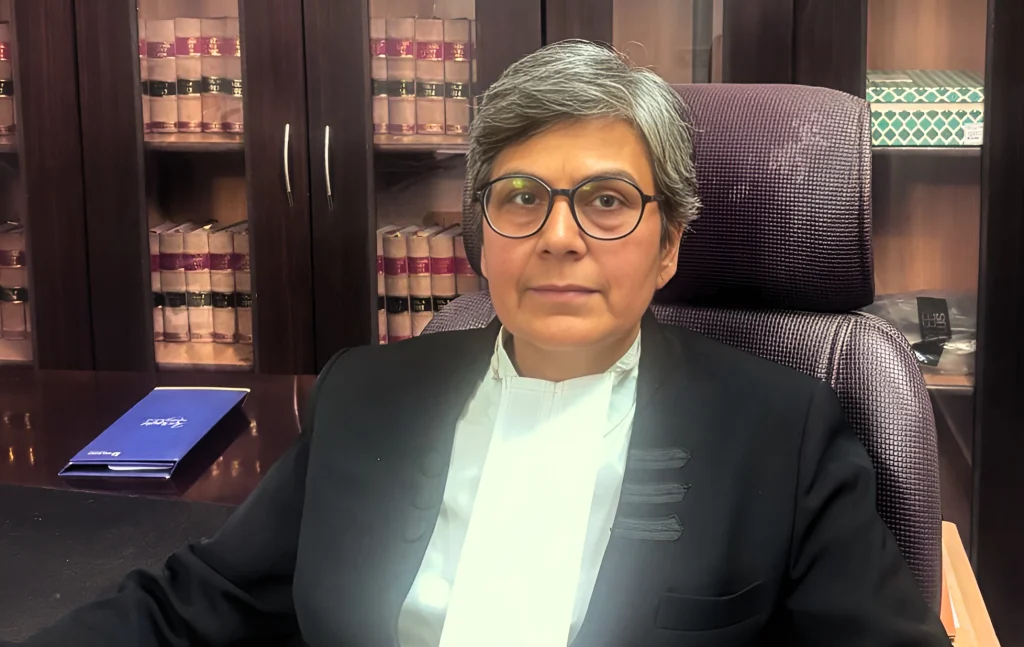

Ms. Kaveeta Wadia, Senior Advocate designated by the Hon’ble Supreme Court of India, shares her experiences from over three decades at the Bar, reflecting a distinguished practice before the Supreme Court and various High Courts. Her work spans constitutional, service, criminal and regulatory jurisprudence, with representation of several State Governments, statutory authorities and public institutions in matters of significant public importance. Her experiences reflect sustained commitment, professional discipline and a deep engagement with public law and advocacy.
This interview has been published by Anshi Mudgal and The SuperLawyer Team
As a first generation lawyer entering the profession in the mid 1990s, how did you view the legal world then and what expectations did you carry into it?
Well, the legal world was inspiring & challenging, and coming straight away to practice at the Supreme Court was awestruck. However, I did realise that I will have to work extraordinarily hard and be extremely focused. I always knew that I have to create a niche for myself in terms of work ethics, and that helped me all along, even after becoming an Advocate-on-Record. It is that passion and focus that can kept me going despite the challenges of being a first-generation lawyer, also because I took the tag of first gen lawyer as a blessing in disguise instead of weakness, I converted it into my strength.
Training under leading names early in your career, which lessons most strongly shaped your courtroom instincts and professional discipline?
Professional discipline punctuality is something which I learnt from my first senior, Justice Indu Malhotra (Retd), Judge, Supreme Court of India. Apart from being extremely thorough in the brief that a lawyer holds, she would insist that we should hear the argument while sitting inside the court, instead of corridor gossip.

Courtroom instincts is something that I really improved upon by my second senior Mr. Maninder Singh, Senior Advocate, apart from learning the focus and commitment required in the profession. Both my seniors often insisted upon being extremely focused and intuned with the law.
Courtroom instinct is something that I find tuned a lot with my second senior in terms of how to be far-sighted in taking even a limited relief from the court for the clients, and at the same time being fair to the court. Both of them were extremely strict in terms of being disciplined professionally inside and outside the court. So, yes, both of them in their own way have been the most influencing factors in shaping me as a counsel.
Was there a single turning point that fundamentally shaped the direction of the practice you have today?
Well, there can’t be any single turning point, because every turn in the profession helped me grow, and becoming a lawyer is itself a major turning point, and then being based in Supreme Court and clearing my Advocate-on-Record examination was significant step forward, which helped me to become and aim for counsel practice.
I got many opportunities to argue when there are clients was not in a position to engage seniors. Even after designation as senior advocate by the Supreme Court, the learning process continues. That is the reason they say that ‘we are all students of law’.
Becoming an Advocate-on-Record at a time when very few women had done so, what responsibilities and pressures came with that role?
Well, the responsibilities and pressure as an Advocate-on-Record were always immense. Yes, being a woman, it always weighed in my mind that the judges should not think I have come here for a timepass, since that was the image any seriously committed professional would avoid.
As a women Advocate-on-Record, it would be difficult to convince even the client that I am as committed as any male Advocate-on Record. So, it was always a pressure that my drafting should be good, my filing should be good, and I don’t ignore my profession because of domestic commitments. However, time and commitment is the only answer to such responsibilities and pressures.
Before establishing a successful practice, what were the most significant challenges you faced in your early years?
Well, the significant challenge is always to convince the client, instructing advocate, and the judges that you are as serious practitioner sans any significant legal background. So, initially, even if the work is less, one has to prove oneself with every matter that you have. It is like you have to pass a test every single time, with no scope of human error also.
Having handled matters ranging from service law to constitutional litigation, which case or phase tested you the most professionally?
Well, I can’t pinpoint any case, because for me every case is professionally a challenge. When you are based in the Supreme Court, you can’t expect any case to be a cake walk. So, as an Advocate-on-Record, an arguing counsel prior to designation, and now after the designation, every case that you feel the litigant would suffer immensely, to me, is a case that tests me professionally.
A case where a mother has to fight for her son, a litigant has to fight for a government job and/or his FRs, is a testing case. God blessed me with the strength to contribute my best to such cases. Yet what left a huge impact on my practice was a service law dispute from the State of Himachal Pradesh, since on the same issue I had lost in a previous litigation from another state, so it took everything that I had learnt to have that adjudicated successfully.
Then there was a case of a mother who fought for her child’s custody and her rights. This custody battle continues to test me even now. I would stop at these two matters for now.
Balancing long standing government empanelments with an independent practice requires constant management. How have you navigated this alongside your personal life?
Well, initially, when I was no longer an Advocate-on-Record for the State of Haryana, for some time I had very little work. Thereafter, when I resigned from Legal Head, Legal Cell at Delhi for the State of Punjab, there was again a slight dip in the practice; however, since I had balanced both nicely without lack of commitment to my responsibilities as state counsel and/or as private counsel, after sometime things smoothened and the challenges continue.
There is no straight jacket formula to balance Government empanelments and independent practice, but yes, one has to be constantly vigil, because in our times there was no message that would come from the registry about the listings. So, the internal discipline of the office and the staff is the key which has to be managed.
I could navigate well because I enjoyed my profession. Personal life has to go for a toss initially, and with time, even though personal life suffers, one manages to learn that something has to be given away to focus on a larger purpose in life.
Being designated a Senior Advocate in 2024 marked a defining milestone. What did that recognition mean to you at a personal and professional level?
At a personal level it meant a lot because for about 6 to 7 years I had always enjoyed arguing and would sit in the court to learn from stalwarts of my time. So, personally yes a huge achievement which strengthened my belief that my perseverance will always take me forward.
Is there a guiding principle or motto that has stayed with you through the years, and how do you envision the future of your practice?
Well, the guiding principle or motto is punctuality and being thorough with the brief and not to take things lightly. For future I would rather not talk about, I like to live in the present but yes I would like to jurisprudentially contribute as much as I can provided the opportunities and path of opportunities kept open for counsels like me.
After having a thriving Supreme Court practice for over three decades, what advice would you offer young lawyers, especially women, who are still navigating uncertain phases of their careers?
Well, I began in 1995 that would make it 31 years primarily in the Supreme Court of India, and my only advice would be not to highlight your gender or not litigation background so much as to render it a weakness. Your discipline and commitment to keep the nobility of the profession alive will itself convert your perceived weaknesses as your strength. So, focus on making the perceived weakness of gender as your strength and you will thrive in the profession.
Get in touch with Ms. Kaveeta Wadia –