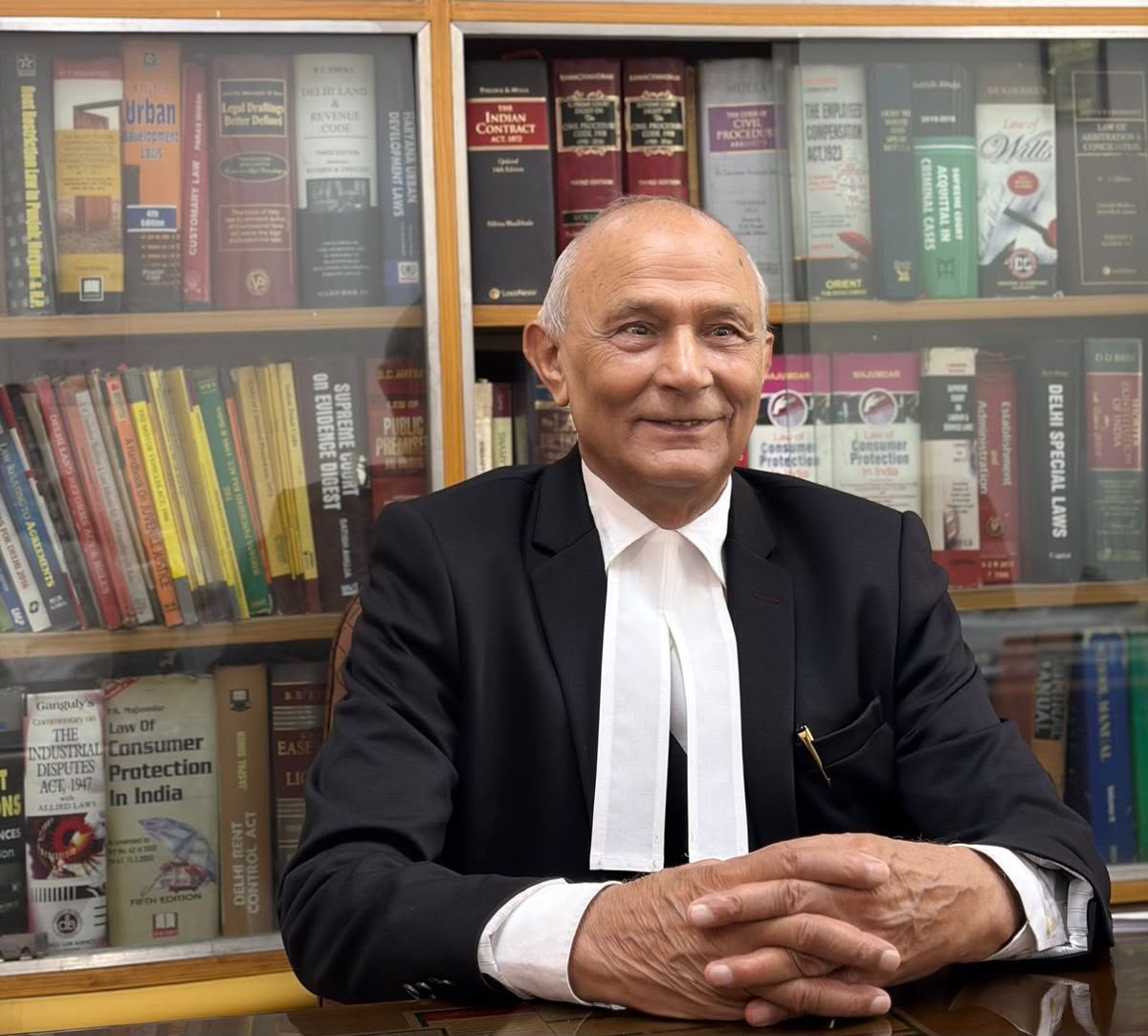
Shish Pal Laler is a seasoned advocate and Co-Founder of Laler Giri, with a legal career spanning nearly five decades across constitutional law, service law, criminal law, civil litigation, and public law matters. Beginning his practice in 1978 at the District Courts in Kurukshetra, he went on to appear before the Punjab & Haryana High Court and the Supreme Court of India, while also serving as Deputy Advocate General for the State of Haryana and representing government bodies, universities, banks, public institutions, and private litigants. In this interview, he reflects on his early years at the Bar, the mentors and courtroom experiences that shaped his approach to advocacy, the responsibilities that come with representing the State, and the principles of honesty, preparation, and professional integrity that have guided him throughout his career. He also shares the vision behind Laler Giri and his advice to young lawyers entering the profession today.
This interview has been published by Rakshit Rajput and The SuperLawyer Team
Looking back at your days as a law student at Kurukshetra University, what first drew you to the legal profession, and when did you realize advocacy was where you truly belonged?
During my time at Kurukshetra University, I was elected General Secretary of the Students’ Union and later contested for President. That experience of representing students and standing up for their concerns made me realise that advocacy was the profession best suited to me. I wanted to use the law to help those in need and give a voice to people facing difficulties. My father, who was an agriculturist, also encouraged me to pursue law rather than take up a conventional job. After completing my M.A. and LL.B., I began practising at the District Court in Kurukshetra, Haryana, in 1978.
The transition from studying law to standing before judges is often the toughest phase of a lawyer’s career. What were those early years of practice like for you, and which experience shaped the advocate you eventually became?
The early years of practice were certainly challenging because a young advocate has to earn the confidence of both clients and the court. I was fortunate to begin under Shri Amar Singh, Advocate, whom I consider my mentor and godfather in the profession. He was an experienced lawyer practising across criminal, civil, and revenue matters, which gave me broad exposure from the very beginning. I was eventually entrusted mainly with criminal cases. My first case remains particularly memorable because I argued it independently and succeeded in securing an acquittal. That experience taught me the importance of careful preparation, testing the credibility of witnesses, and identifying inconsistencies in the evidence. With each case, cross-examination and courtroom advocacy became more natural, and those early experiences laid the foundation for my journey from the trial courts to appearing before the highest court of the country.
Nearly five decades of practice have taken you before the Supreme Court and various high courts representing governments, universities, banks, and private litigants alike. What has stayed consistent in your approach, no matter who you’re appearing for?
For me, the one thing that has never changed is honesty, both with the court and with my client. I have always believed that before I argue a case, I must first understand my client’s facts completely and honestly. I spend a great deal of time listening to the client, because only then can I present the case in its true perspective. I have never believed in creating a story simply to strengthen a matter. If the facts or the law do not support the relief being sought, I tell the client so clearly. Over the years, I have found that when you are truthful, well prepared, and clear in your submissions, the court also responds with greater confidence in what you place before it.
In 1998, you were appointed as Deputy Advocate General for the state of Haryana. What did you feel the day you realized you were now the one framing the state’s legal profession rather than arguing against it?
For me, the appointment as Deputy Advocate General, Haryana, was an opportunity to serve the State after nearly two decades in practice. Representing the government brought a different sense of responsibility because I was no longer appearing only for an individual client, but for the State itself. At times, there were matters where I had to examine very carefully whether the action taken against a person was legally justified, and that responsibility stayed with me. By then, however, I had almost 20 years of experience, particularly in criminal, civil, and service matters, which gave me the confidence to discharge my duties effectively. My years in the District Courts and later before the High Court had prepared me well for representing Haryana in important matters, including those before the Supreme Court.
Across 45 plus years of constitution and service law practice, which matter challenges you the most, and what lasting impact did it have on you as a lawyer?
It is difficult for me to single out one matter because, over more than four decades of practice, I have represented ministers, MLAs, bureaucrats, engineers, doctors, academicians, and many private litigants in complex constitutional and service matters. What stayed with me most was the realization that the stature of the client never makes a case strong, the facts do. I have always tried to assess a matter honestly before accepting it, and if I felt that the law and facts offered little possibility of success, I preferred to tell the client so clearly rather than give false hope. That approach shaped me deeply as a lawyer. It taught me that preparation, judgment, and the courage to decline a weak brief are just as important as the ability to argue a strong one.
Having represented the government of Haryana and other public institutions for decades, what responsibility comes with advocating for clients whose decisions often have a wider public impact?
For me, representing the government or a public institution has always carried a special responsibility, because the impact of the advice often goes far beyond one case or one department. I have always felt that my duty was not simply to defend every decision placed before me, but to tell the authorities honestly when a case was weak, when the law was already settled, or when further litigation would only add to the burden of the courts and the parties involved. Over the years, while representing the State, universities, and banks, I often advised clients to accept a correct order rather than appeal it unnecessarily. I believe that a government lawyer serves the institution best when he has the courage to give fair advice, even when that advice is not the easiest one to give.
After more than 45 years of independent practice, many lawyers would choose to slow down instead. You co-founded Laler Giri. What inspired this new chapter, and what vision do you hope the firm represents in the years ahead?
For me, this profession was never only about earning; it was always about earning trust and a good reputation. I entered law believing it to be a noble profession and a means of helping people who genuinely need support. That belief has stayed with me throughout my career. Co-founding Laler Giri was, in many ways, a continuation of that philosophy. I wanted to create a firm where young lawyers could learn the value of honest, fair, and responsible practice, while also protecting the interests of litigants with sincerity. My hope is that the firm grows not merely as a successful legal practice, but as an institution known for integrity, professional standards, and for setting the right example for the next generation of lawyers.
Looking back across nearly five decades in the profession, what is the biggest shift in how you approach a case today compared to when you started in 1978?
When I started practice in 1978, preparing a case was a very different experience. I remember spending long hours going through AIR, SCC, digests, and law journals, sometimes in libraries where even finding an old judgment could be difficult. Today, technology has made legal research much faster, and that has certainly changed the way I work. But personally, I still do not like to rely blindly on what a search result or technology gives me. I prefer to read the judgment myself, understand the facts, and see how the law actually applies to the case before me. So, while the tools have changed completely, my habit of preparing a matter carefully has remained the same.
Finally, if you had the opportunity to mentor the young lawyers on their very first day of practice, what advice would you share that only 45 years of courtroom experience could teach?
If I were speaking to a young lawyer on the first day of practice, I would tell them to first learn to listen. Understand the client’s facts completely, study the law carefully, and have the courage to say no when there is no real case. Honest advice may not always please a client, but over time it builds the reputation on which a strong practice stands. I would also tell them not to be discouraged by the first few years. This profession may not reward you financially in the beginning, but every well-prepared case, every good argument, and every client who trusts you becomes an investment in your future. Respect the court, respect your colleagues, remain patient, and never compromise your integrity. After nearly five decades in practice, I believe that if you serve the profession sincerely, it eventually gives you both respect and success.
Get in touch with Shish Pal Laler –
Leave a Reply